Midterm 1 (Practice)
Name: ________________________
Date: ________________________
| Problem | Points | Score |
|---|---|---|
| 1 | 7 | |
| 2 | 8 | |
| 3 | 9 | |
| 4 | 6 | |
| Total | 30 |
You are responsible for following the instructions below:
Write neatly, box answers, and show work. I want to give you partial credit if possible!
Do not refer to calculators, computational engines, or other outside resources.
Do not discuss the exam with anyone before it is due.
Do not share copies of the exam for any reason.
Good luck!
I agree to these conditions and furthermore I understand that failing to follow these instructions (e.g., by using or accessing disallowed resources, sharing exam materials, etc.) is a violation of academic integrity as defined within the Carleton College student handbook: https://apps.carleton.edu/handbook/.
On my honor, I have neither received or given unauthorized assistance on this examination!
Signature: ________________________
Cheatsheet
Derivatives \[ \begin{aligned} \frac{\mathop{}\!\mathrm{d}}{\mathop{}\!\mathrm{d}x} x^n &= n \, x^{n-1} & \frac{\mathop{}\!\mathrm{d}}{\mathop{}\!\mathrm{d}x} \ln(x) &= \frac{1}{x} \\[1.5em] \frac{\mathop{}\!\mathrm{d}}{\mathop{}\!\mathrm{d}x} e^x &= e^x & \frac{\mathop{}\!\mathrm{d}}{\mathop{}\!\mathrm{d}x} \sin^{-1}(x) &= \frac{1}{\sqrt{1-x^2}} \\[1.5em] \frac{\mathop{}\!\mathrm{d}}{\mathop{}\!\mathrm{d}x} \sin(x) &= \cos(x) & \frac{\mathop{}\!\mathrm{d}}{\mathop{}\!\mathrm{d}x} \cos^{-1}(x) &= \frac{-1}{\sqrt{1-x^2}} \\[1.5em] \frac{\mathop{}\!\mathrm{d}}{\mathop{}\!\mathrm{d}x} \cos(x) &= -\sin(x) & \frac{\mathop{}\!\mathrm{d}}{\mathop{}\!\mathrm{d}x} \tan^{-1}(x) &= \frac{1}{1+x^2} \\[1.5em] \frac{\mathop{}\!\mathrm{d}}{\mathop{}\!\mathrm{d}x} \tan(x) &= \sec^2(x) & \frac{\mathop{}\!\mathrm{d}y}{\mathop{}\!\mathrm{d}x} &= \frac{\mathop{}\!\mathrm{d}y}{\mathop{}\!\mathrm{d}u} \frac{\mathop{}\!\mathrm{d}u}{\mathop{}\!\mathrm{d}x} \\[1.5em] \frac{\mathop{}\!\mathrm{d}}{\mathop{}\!\mathrm{d}x} (f(x) \cdot g(x)) &= f'(x) g(x) + f(x) g'(x) & \frac{\mathop{}\!\mathrm{d}}{\mathop{}\!\mathrm{d}x} \left( \frac{f(x)}{g(x)} \right) &= \frac{f'(x) g(x) - f(x) g'(x)}{g(x)^2} \\[1.5em] \end{aligned} \]
Integrals \[ \begin{aligned} \int x^n \mathop{}\!\mathrm{d}x &= \frac{x^{n+1}}{n+1} + C, \; n \ne -1 & \int \frac{1}{x} \mathop{}\!\mathrm{d}x &= \ln |x| + C \\[1.5em] \int e^x \mathop{}\!\mathrm{d}x &= e^x + C & \int \frac{1}{1+x^2} \mathop{}\!\mathrm{d}x &= \tan^{-1}(x) + C \\[1.5em] \int \sin(x) \mathop{}\!\mathrm{d}x &= -\cos(x) + C & \int \frac{1}{\sqrt{1-x^2}} \mathop{}\!\mathrm{d}x &= \sin^{-1}(x) + C \\[1.5em] \int \cos(x) \mathop{}\!\mathrm{d}x &= \sin(x) + C & \int u \mathop{}\!\mathrm{d}v &= uv - \int v \mathop{}\!\mathrm{d}u \\[1.5em] \end{aligned} \]
Logarithms, Inverse trigonometric functions, Polynomials, Exponentials, Trigonometric functions
Improper Integrals & Identities \[\begin{aligned} \int_1^\infty \frac{1}{x^p} \mathop{}\!\mathrm{d}x &= \frac{1}{p-1} \text{ for } p>1 \quad (\text{diverges for } p \le 1) & \int_0^\infty e^{-x} \mathop{}\!\mathrm{d}x &= 1 \\[1.5em] \ln(ab) &= \ln(a)+\ln(b) & \sin^2(x) + \cos^2(x) &= 1 \\[1.5em] \ln(a/b) &= \ln(a)-\ln(b) & \tan^2(x)+1 &= \sec^2(x) \\[1.5em] \ln(a^c) &= c \ln(a) & \sin(0) = \cos(\tfrac{\pi}{2}) &= 0 \\[1.5em] \end{aligned}\]
Exam
Problem 1. (7 points) Evaluate the following limits:
(1 points) \(\displaystyle \lim_{u \to 0} \frac{\sin(u^2)-u}{\cos(3u)-1}\)
NoteClick for SolutionDirect substitution yields \(\frac{0}{0}\). Applying L’Hôpital’s Rule gives: \[ \lim_{u \to 0} \frac{\sin(u^2)-u}{\cos(3u)-1} = \lim_{u \to 0} \frac{2u \cos(u^2) - 1}{-3 \sin(3u)}. \] As \(u \to 0\), the numerator approaches \(-1\), while the denominator approaches \(0\). Since \(\sin(3u)\) changes sign across \(u = 0\), the left-hand limit is \(+\infty\) and the right-hand limit is \(-\infty\). Therefore, the limit does not exist (diverges to \(\pm\infty\)).
(1 points) \(\displaystyle \lim_{t \to \infty} \frac{(\ln t)^2}{t+4}\)
NoteClick for SolutionThis presents an indeterminate form of type \(\frac{\infty}{\infty}\). Applying L’Hôpital’s Rule: \[ \lim_{t \to \infty} \frac{(\ln t)^2}{t+4} = \lim_{t \to \infty} \frac{2 \ln(t) \cdot \frac{1}{t}}{1} = \lim_{t \to \infty} \frac{2 \ln t}{t}. \] Applying L’Hôpital’s Rule a second time: \[ \lim_{t \to \infty} \frac{2 \ln t}{t} = \lim_{t \to \infty} \frac{2/t}{1} = 0. \]
(1 points) \(\displaystyle \lim_{t \to 0^+} \frac{\sin t}{\ln t}\)
NoteClick for SolutionThis is not an indeterminate form. Evaluating the limits directly: \[ \lim_{t \to 0^+} \sin t = 0 \quad \text{and} \quad \lim_{t \to 0^+} \ln t = -\infty. \] Thus, \(\frac{0}{-\infty} = 0\).
Explain how you would evaluate the following integrals, given sufficient time and desire. Describe the functions you expect in the result and why. Do not compute these integrals.
(2 points) \(\displaystyle \int x^{2026} e^{-x} \mathop{}\!\mathrm{d}x\)
NoteClick for SolutionUse Integration by Parts iteratively (\(2026\) times), setting \(u = x^{2026}\) and \(\mathop{}\!\mathrm{d}v = e^{-x} \mathop{}\!\mathrm{d}x\). Each step reduces the polynomial power by \(1\). The final anti-derivative will consist of \(e^{-x}\) multiplied by a complete 2026th-degree polynomial plus a constant \(C\).
(2 points) \(\displaystyle \int \frac{1}{(x-1)(x-2)(x-3)(x-4)(x-5)(x-6)} \mathop{}\!\mathrm{d}x\)
NoteClick for SolutionUse Partial Fraction Decomposition to decompose the integrand into six distinct terms of the form \(\frac{A_k}{x-k}\) for \(k = 1, \dots, 6\). Integrating term-by-term will yield a linear combination of natural logarithms: \[ A_1 \ln|x-1| + A_2 \ln|x-2| + \cdots + A_6 \ln|x-6| + C. \]
Problem 2. (8 points) Evaluate the following:
(2 points) \(\displaystyle \frac{\mathop{}\!\mathrm{d}}{\mathop{}\!\mathrm{d}x} \tan^{-1}(x)\). (Derive the identity from the exam table)
NoteClick for SolutionLet \(y = \tan^{-1}(x)\), which implies \(\tan(y) = x\). Differentiating implicitly with respect to \(x\): \[ \sec^2(y) \frac{\mathop{}\!\mathrm{d}y}{\mathop{}\!\mathrm{d}x} = 1 \quad \Longrightarrow \quad \frac{\mathop{}\!\mathrm{d}y}{\mathop{}\!\mathrm{d}x} = \frac{1}{\sec^2(y)} = \cos^2(y). \] Using the trigonometric identity \(\tan^2(y) + 1 = \sec^2(y)\), we have \(\sec^2(y) = x^2 + 1\). Thus: \[ \frac{\mathop{}\!\mathrm{d}}{\mathop{}\!\mathrm{d}x} \tan^{-1}(x) = \frac{1}{1+x^2}. \]
(3 points) \(\displaystyle \int x^2 \cos x \mathop{}\!\mathrm{d}x\).
NoteClick for SolutionApply integration by parts with \(u = x^2\) and \(\mathop{}\!\mathrm{d}v = \cos x \mathop{}\!\mathrm{d}x\), giving \(\mathop{}\!\mathrm{d}u = 2x \mathop{}\!\mathrm{d}x\) and \(v = \sin x\): \[ \int x^2 \cos x \mathop{}\!\mathrm{d}x = x^2 \sin x - 2 \int x \sin x \mathop{}\!\mathrm{d}x. \] Apply integration by parts a second time with \(u = x\) and \(\mathop{}\!\mathrm{d}v = \sin x \mathop{}\!\mathrm{d}x\), giving \(\mathop{}\!\mathrm{d}u = \mathop{}\!\mathrm{d}x\) and \(v = -\cos x\): \[ \int x \sin x \mathop{}\!\mathrm{d}x = -x \cos x + \int \cos x \mathop{}\!\mathrm{d}x = -x \cos x + \sin x. \] Combining these results yields: \[ \int x^2 \cos x \mathop{}\!\mathrm{d}x = x^2 \sin x + 2x \cos x - 2 \sin x + C. \]
(3 points) \(\displaystyle \int \cos x \; \ln (\sin x) \mathop{}\!\mathrm{d}x\).
NoteClick for SolutionFirst, substitute \(w = \sin x\) with \(\mathop{}\!\mathrm{d}w = \cos x \mathop{}\!\mathrm{d}x\): \[ \int \cos x \ln (\sin x) \mathop{}\!\mathrm{d}x = \int \ln(w) \mathop{}\!\mathrm{d}w. \] Integrate \(\ln(w)\) by parts using \(u = \ln w\) and \(\mathop{}\!\mathrm{d}v = \mathop{}\!\mathrm{d}w\): \[ \int \ln(w) \mathop{}\!\mathrm{d}w = w \ln(w) - \int w \cdot \frac{1}{w} \mathop{}\!\mathrm{d}w = w \ln(w) - w + C. \] Substituting back \(w = \sin x\): \[ \sin x \ln(\sin x) - \sin x + C. \]
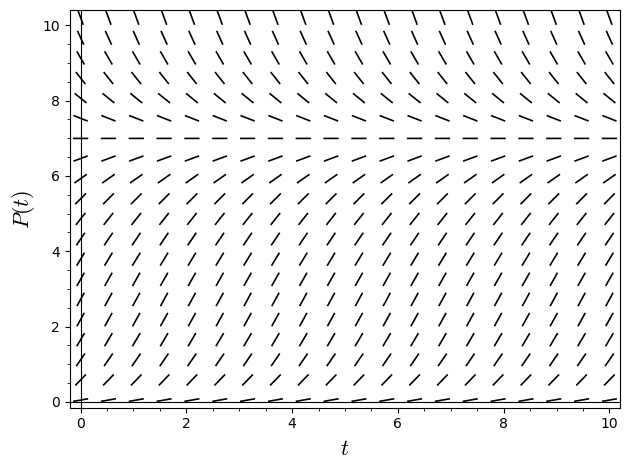
Problem 3. (9 points) In class we studied logistical equations as a more realistic model of population growth. Another model for a growth function with a limited population is given by the Gompertz function, which is a solution of the differential equation \[ \frac{\mathop{}\!\mathrm{d}P}{\mathop{}\!\mathrm{d}t} = k \ln\left| \frac{M}{P} \right| P \] where \(M\) is the usual carrying capacity and \(k\) is some constant of proportionality. For this problem, we will fix the constants \(k=1\) and \(M=7\): \[ \frac{\mathop{}\!\mathrm{d}P}{\mathop{}\!\mathrm{d}t} = \ln\left| \frac{7}{P} \right| P \tag{1}\] We will assume henceforth that solutions \(P(t)\) describe the population of some species, measured in thousands of individuals, at time \(t\), measured in years.
(2 points) Using the following slope field, sketch solutions to equation (Equation 1) for the initial values \(P(0) = 1, P(0) = 3, P(0) = 5,\) and \(P(0) = 7\).
NoteClick for SolutionSolutions starting below \(P=7\) increase concavely upward towards \(P=7\). The line \(P(0)=7\) remains constant at \(P(t)=7\) for all \(t \ge 0\).
(2 points) The differential equation (Equation 1) is not defined when \(P = 0\). Can we remove this discontinuity, i.e., can we define \(\frac{\mathop{}\!\mathrm{d}P}{\mathop{}\!\mathrm{d}t}\) to be some value at \(P=0\) in such a way that \(\left.\frac{\mathop{}\!\mathrm{d}P}{\mathop{}\!\mathrm{d}t}\right|_{P=0} = {\displaystyle \lim_{P \to 0^+}} \frac{\mathop{}\!\mathrm{d}P}{\mathop{}\!\mathrm{d}t}\)?
NoteClick for SolutionYes. Evaluating the limit using L’Hôpital’s Rule: \[ \lim_{P \to 0^+} P \ln\left(\frac{7}{P}\right) = \lim_{P \to 0^+} \frac{\ln(7) - \ln(P)}{1/P} = \lim_{P \to 0^+} \frac{-1/P}{-1/P^2} = \lim_{P \to 0^+} P = 0. \] Thus, defining \(\left.\frac{\mathop{}\!\mathrm{d}P}{\mathop{}\!\mathrm{d}t}\right|_{P=0} = 0\) removes the removable discontinuity.
(2 points) What are the steady state solutions to (Equation 1)? Determine if the steady states are stable, semistable, or unstable by drawing a phase portrait. What do they physically represent?
Note: The phase portrait I ask you to sketch on the Midterm will be easier than this one—you should use SageMath here to check your work, then think about the qualitative parts of the question.
NoteClick for SolutionSetting \(\frac{\mathop{}\!\mathrm{d}P}{\mathop{}\!\mathrm{d}t} = 0\) yields steady states at \(P = 0\) and \(P = 7\).
- For \(0 < P < 7\), \(\frac{7}{P} > 1 \implies \ln(7/P) > 0 \implies \frac{\mathop{}\!\mathrm{d}P}{\mathop{}\!\mathrm{d}t} > 0\) (arrows point up, toward 7).
- For \(P > 7\), \(\frac{7}{P} < 1 \implies \ln(7/P) < 0 \implies \frac{\mathop{}\!\mathrm{d}P}{\mathop{}\!\mathrm{d}t} < 0\) (arrows point down, toward 7).
Thus, \(P = 7\) is a stable equilibrium (carrying capacity of 7,000 individuals), and \(P = 0\) is an unstable equilibrium (extinction state).
(3 points) Describe what this model suggests will happen to a starting population of 2,000 individuals (that is, \(P(0)=2\)). Support your argument by solving the initial value problem (Equation 1) subject to the initial condition \(P(0) = 2\).
NoteClick for SolutionSeparating variables gives us: \[ \frac{\mathop{}\!\mathrm{d}P}{P \ln(7/P)} = \mathop{}\!\mathrm{d}t. \] We integrate and substitute \(u = \ln(7/P)\), so \(\mathop{}\!\mathrm{d}u = -\frac{1}{P} \mathop{}\!\mathrm{d}P\): \[ -\int \frac{\mathop{}\!\mathrm{d}u}{u} = \int \mathop{}\!\mathrm{d}t \implies -\ln|u| = t + C_1 \implies \ln(7/P) = C e^{-t}. \] Apply the initial condition \(P(0) = 2\), \[ \ln(7/2) = C e^0 \implies C = \ln(3.5), \] and the exponentiate both sides: \[ \frac{7}{P(t)} = e^{\ln(3.5)e^{-t}} = (3.5)^{e^{-t}} \implies P(t) = 7 \left(\frac{2}{7}\right)^{e^{-t}}. \] As \(t \to \infty\), \(e^{-t} \to 0\), so we have \((2/7)^0 = 1\) and thus \(P(t) \to 7\). The population will increase over time and asymptotically approach the carrying capacity of 7,000 individuals.
Problem 4. (6 points)
(2 points) Determine if the given function is a solution of the differential equation: \[ y(t) = \sqrt{t} \quad \text{ for } \quad t y'- y = 0. \]
NoteClick for SolutionDifferentiating \(y(t) = t^{1/2}\) yields \(y'(t) = \frac{1}{2\sqrt{t}}\). Substituting into the left side: \[ t \left(\frac{1}{2\sqrt{t}}\right) - \sqrt{t} = \frac{\sqrt{t}}{2} - \sqrt{t} = -\frac{\sqrt{t}}{2} \neq 0. \] Since this does not equal \(0\), \(y(t) = \sqrt{t}\) is not a solution.
(2 points) Evaluate the following improper integral: \[ \int_{-\infty}^\infty \frac{1}{x^2+1} \mathop{}\!\mathrm{d}x. \]
Hint: If you identify symmetry that can simplify this problem, you are encouraged to use it!
NoteClick for SolutionSince the integrand is an even function, we can simplify using symmetry: \[ \int_{-\infty}^\infty \frac{1}{x^2+1} \mathop{}\!\mathrm{d}x = 2 \int_0^\infty \frac{1}{x^2+1} \mathop{}\!\mathrm{d}x = 2 \lim_{t \to \infty} \left[ \tan^{-1}(x) \right]_0^t = 2 \left( \frac{\pi}{2} - 0 \right) = \pi. \]
(2 points) Determine if the following integral converges: \[ \int_1^\infty \frac{1+e^{-x}}{x \sqrt{x}} \mathop{}\!\mathrm{d}x. \] Do not evaluate the integral!
NoteClick for SolutionFor all \(x \ge 1\), we have \(0 < e^{-x} \le e^{-1} < 1\), so \(1 \le 1 + e^{-x} \le 2\). Thus: \[ 0 \le \frac{1+e^{-x}}{x^{3/2}} \le \frac{2}{x^{3/2}}. \] The integral \(\int_1^\infty \frac{2}{x^{3/2}} \mathop{}\!\mathrm{d}x\) converges by the \(p\)-test (\(p = 3/2 > 1\)). Therefore, by the Direct Comparison Test, \(\int_1^\infty \frac{1+e^{-x}}{x \sqrt{x}} \mathop{}\!\mathrm{d}x\) converges.