20 Lagrange multipliers II
The Lagrangian combines the objective function \(f\) and the constraint function \(g\):
\[\mathcal{L}(x_1,\dots,x_n,\lambda) = f(x_1,\dots,x_n) - \lambda ( g(x_1,\dots,x_n) - c ).\]
This auxiliary function is useful because its gradient encodes the \(n+1\) Lagrange equations:
\[\nabla \mathcal{L} = \langle f_{x_1} - \lambda g_{x_1}, \cdots, f_{x_n} - \lambda g_{x_n}, g - c \rangle.\]
The critical points (the stationary points) of the Lagrangian are the solutions to our optimization problem.
We want to optimize \(f(x_1,\dots,x_n)\) subject to a constraint \(g(x_1,\dots,x_n) = c\).
- Compute the gradient of the Lagrangian \(\mathcal{L}(x_1,\dots,x_n,\lambda) = f - \lambda (g-c)\),
- Set \(\nabla \mathcal{L} = 0\) (a system of equations) and solve to find stationary points, and
- Plug the stationary points into \(f(x_1,\dots,x_n)\) to determine extreme values.
We take \(f(x,y) = (x - 2)^2 + y^2\) (since the square of a function inherits critical points), \(g(x,y) = x^2 - 5 y^2\), and \(c = 1\), which gives the stationary points \((-1, 0, 3), (1, 0, -1), (\tfrac{5}{3}, -\tfrac{4}{3\sqrt{5}}, -\frac{1}{5}), (\tfrac{5}{3}, \tfrac{4}{3\sqrt{5}}, -\frac{1}{5})\). The last two give minima (\(f=\frac{7}{15}\)), and all are visualized below in red:
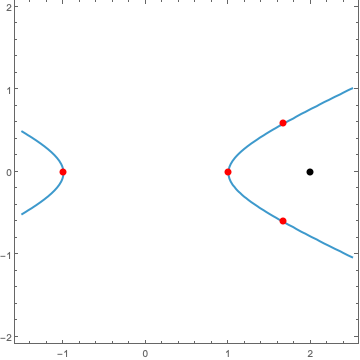
What is the significance of the points that did not give the absolute minimum?
This code solves the above system, and can be used to check your solutions in Homework.
f = (x - 2)^2 + y^2;
g = x^2 - 5 y^2;
c = 1;
L = f - λ (g - c);
gradL = Grad[L, {x, y, λ}];
solutions = Solve[gradL == 0, {x, y, λ}, Reals]
f /. solutions
Try modifying the code to solve problems in more variables!
The stationary points of the Lagrangian are: \[(0, 0, 0), (\tfrac{1}{\sqrt{5}}, \tfrac{2}{\sqrt{5}}, \tfrac{3}{5 \sqrt{5} e}), (-\tfrac{1}{\sqrt{5}}, -\tfrac{2}{\sqrt{5}}, -\tfrac{3}{5 \sqrt{5} e}).\] The first is the minimum (\(f=0\)) and the last two are maxima (\(f=\frac{2}{5e}\)).